


By Thomas Weston
Introduction
The use of colour rings are widely used to increase the recovery rate of birds, meaning the individuals do not need to be recaught again. However, through the use of binoculars and cameras, colour rings can be read in the field, and submitted to national colour ringing projects increasing the number of resightings of an individual or population. Dan Gornall aims to understand the movements of Yellow-browed Warbler within Western Europe, through the use of colour ringing individuals throughout the UK. Dan's project aims to look at the trajectory of movements, and investigates whether there are subsequent southbound movements after birds initially follow a western trajectory reaching the westernmost limits of Europe in autumn. The use of colour rings reduces the need of recapture, help to identify wintering locations, and to identify stop-over duration of Yellow-browed Warblers arriving in Britain and Ireland. The colour rings are lightweight and used in a combination of colour rings and metal rings consisting of eight different colours used (red, orange, blue, green, yellow, purple, brown and white). Lundy was provided 10 combinations as part of the national colour ringing project, using all 10 in 2024 and resulted in a resighting of one of Lundy's colour ringed birds on the Isles of Scilly. We were then provided another 10 combinations as part of the project, with a single bird caught and colour ringed in 2025. All sightings are sent to Dan via his email:
Aims
To contribute to the wider national colour ringing project by targetting and capturing vagrant Yellow-browed Warblers on the island when they are present.
Methods
Regular mist netting in Millcombe throughout the autumn, alongside ad-hoc ringing when Yellow-browed Warblers were seen on the island were the most successful methods of capture on the island this year. The use of tape lure was used, to attract the individuals towards the net for capture.
Results
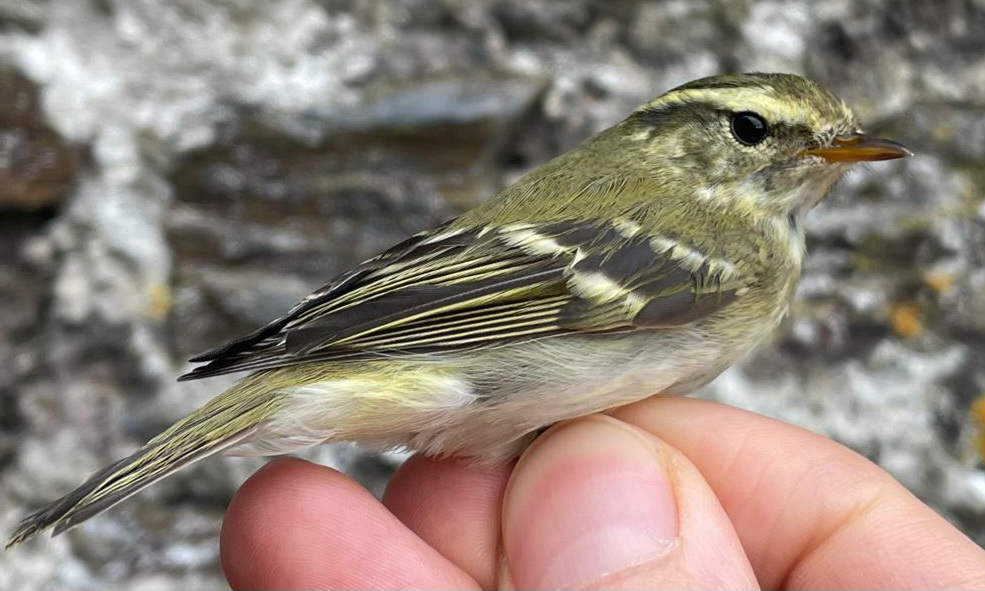 Yellow-browed Warbler caught and ringed in Millcombe by Eleanor Harris
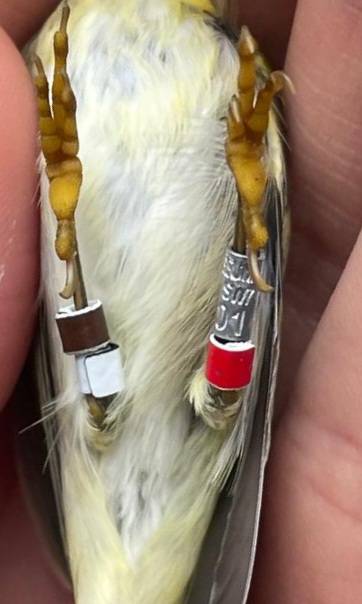 First colour ringed Yellow-browed Warbler in Millcombe by Eleanor Harris
During regular mist netting in Millcombe, two Yellow-browed Warblers were caught and colour ringed on the 4th October 2026. One of the birds was attracted to tape lure in Millcombe, and colour ringed with red, metal on the left leg, and then white, brown on the right leg. The bird was released after ringing and biometrics had been undertaken. The bird was still present around the valley in the afternoon, but no confirmed resightings were made after this date. The next bird caught was ringed 80 minutes later in St John's Valley. The bird was not attracted to a tape lure, but seemingly was moving through the valley with a flock of other warblers. The bird was colour ringed with red, metal on the left leg, and then brown, brown on the right leg. The bird was released after ringing and biometrics, and was seen on the 5th, 6th, 7th and 8th. Moroever, a bird seen and heard in the valley was not determined to be a colour ringed bird, but could have been the second colour ringed individual. During the arrival of these two birds, an additional two unringed birds were seen on the 4th October 2026 with one bird in St Helens and one in Rüppells Quarry. The former unringed bird was seen until the 5th, with the latter seen up to the 14th at least, though was elusive when trying to target this bird. Another unringed bird, the 5th of the year, was seen on 31st October at Rüppells Quarry, with this bird not seen on the morning of the 1st November. However, a sixth and final bird of the year was seen on the 3rd November, passing through Rüppells Quarry heading north and not seen thereafter. The average number of days an individual remained on the island was 4 days, though this was skewed by one long staying individual.
Discussion
The arrival of four Yellow-browed Warblers was noteworthy, with two birds caught and ringed in the Millcombe area. The use of colour rings was intrumental in determining the number of days the birds were present on the island, and the number of individuals recorded throughout the autumn. In total, six Yellow-browed Warblers on the island were recorded, and this was quite low compared to 2024, however more than in 2025. The number of days individuals resided on the island varied between a few minutes to 10 days. The average duration was 4 days, though this was skewed by the bird remaining at Rüppell's Quarry for 11 days. Overall, numbers of individuals on the island, as with the rest of the UK, seem to be increasing in numbers. Two of the birds were caught in Millcombe, though targetting individuals on the east coast will be important to help contributing to the national colour ringing project in future years.
Conclusion
It was great to be able to contribute to the project again this year with two newly colour ringed birds for the project. Albeit, four Yellow-browed Warblers were missed, and left unringed, it will be interesting to see how we can contribute to the project in the future.