




Bird Sightings
16/09/2026 – Census Counts
By Thomas Weston
A stiff north wind today led to a nice census, though the breeziness on the top of the island was not ideal.
Census counts: 3 Mallards, single Woodpigeon, single Water Rail, 2 Oystercatchers, single Great Black-Backed Gull, 3 Herring Gulls, single Lesser Black Backed Gull, single Gannet, 2 migrant Cormorants south, 25 Shags, 2 Peregrines, 52 Carrion Crows, 7 Ravens, 2 Skylarks, 6 Swallows, single Willow Warbler, 8 Chiffchaffs, 22 Blackcaps, 2 Goldcrest, 12 Wrens, 97 Starlings, 2 Blackbirds, 6 Robins, single Stonechat, single Wheatear, 3 House Sparrows, 7 Dunnocks, single Yellow Wagtail, single Pied Wagtail, single White Wagtail, 4 unidentified alba wagtails, 45 Meadow Pipits, single Rock Pipit, single Chaffinch, 14 Linnets, and 7 Goldfinches.
The rest of the day was spent doing admin.
15/09/2026 – A Sign Of Migration
By Thomas Weston
The rain had come through last night, not much but enough to clear the sky of fog and mist.
Swapping census with Greg so he could go ringing with the visiting ringers, it was nice be able to see more than 20m ahead. The clearer skies led to the start of the autumn's Meadow Pipit migration with 86 birds seen throughout the census route, as well as the first 81 Linnets. There was a small increase in Goldfinches, and it was presumed some of these were using the skies to migrate through – a lack of records for this species recently has been a tad odd. However, the count of 7 Blackbirds was good for the residents, and the reappearance of a ringed Song Thrush was interesting. Maybe it is not our funky singing male who sings all spring and summer, but the second bird caught post-breeding? The latter, amazingly, was caught again last week still moulting so it could be sticking around still, and perhaps in slightly poor condition having now been moulting for over a month, hidden for sure. Moreover, there were definitely some Robin migrants on the island as the census count of 18 was particularly high for the route. If it remains mild then this count is likely to increase further. True migrant species were low, and so were the numbers in the nets too, though 2 Spotted Flycatchers, 2 Goldcrests, 2 Willow Warblers, 3 Blackcaps, 2 Chiffchaffs and a single Whitethroat were the best in the bushes. The Village Swallows were loitering around the top of Millcombe, though with some migrants coming through already it is not unlikely some of these could be joined by more soon. Looking out from Battlements Corner, 2 Water Rail in Smelly Gully were the best, though 2 flyby Rock Pipits were excellent to see. With most bird species on the island being migratory to some extent, our 'more' resident species resulted in 3 Chaffinches, 2 Woodpigeons, 14 Wrens, 46 Carrion Crows, 6 Ravens, 17 House Sparrows, 106 Starlings, and 10 Mallards. It seemed that seabird numbers were low on the east, with only 14 Shags of note, though with the cold front having come from the west, seabird numbers were higher with a single Gannet, 8 Kittiwakes, and 5 auk spp, noted. On the Plauteau, a single Ringed Plover migrating over south was not too unexpected, as Greg had 3 earlier in the day, though the 2 Dunlin and 2 Grey Herons with at least one of the former coming in off the sea at Old Light were very unexepected. The Airfield was quiet, though 7 Skylarks, and a single (potentially one of our last?) Wheatear was nice to record. Alongside the expected birds in the Village, Kirsty handed me a box. This was the first of 5 Manx Shearwaters ringed/processed just from the Village including a bird we had ringed from outside the Tavern two days ago, released on the cliffs, and then back again outside the Tavern. No clue what this bird was doing.
14/09/2026 - Strimming and a Skua
By Emma Abel
Another foggy day, the cloud hanging low over the island for an atmospheric day of strimming. As Assistant Ranger my role has had significantly less grass cutting than a usual year due to the ongoing drought conditions. But today was an exception to that as I was given the important task of cutting a length of St John’s Valley free of bracken and brambles to put up new mist nets. Many small eyes watched my movement, the ticking and twittering of a Robin and a small flock of Linnets, hiding safely away in the scrub.
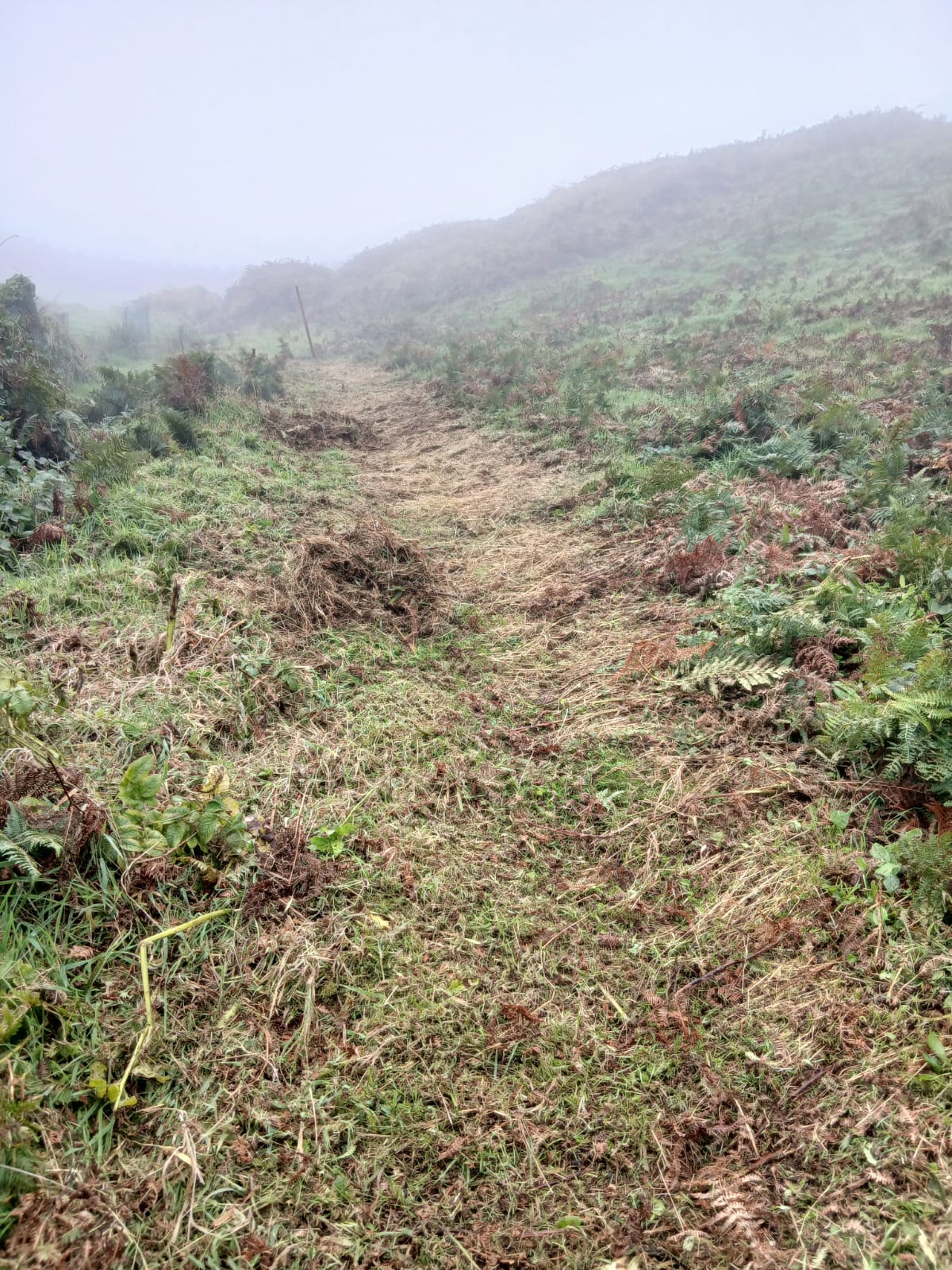 Foggy net rides, ready for a mist net - E Abel
Greg’s census was quiet, with the fog keeping anything that may have been interesting hidden away. However Thomas, Eleanor headed to the North End joined by Chris Dee and experienced a very different weather to the rest of us – sun! As the cloud hung like a cap over the island, down the steps at North Light, these three were sunbathing under blue sky (and doing important monitoring work too, I guess). The clear skies granted them a great view of a Great Skua heading South, a first for the year.
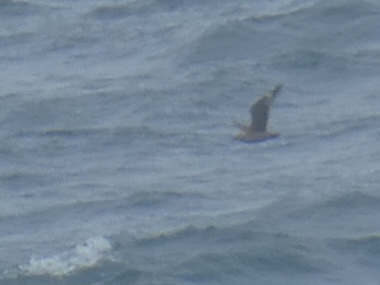 Great Skua passing North Light by Thomas Weston
After an uneventful census, Greg headed out in the afternoon and had more luck with a Grey Heron passing the Landing Bay and a Dunlin flying over St Johns Valley. This bird was likely seen on the track near Tibbets later that day by a visitor. Making his way into Quarter Wall Copse, Greg spotted a Pied Flycatcher and was also greeted by the Western Bonelli’s Warbler still hanging around, seemingly refusing to leave Lundy for the moment.
13/09/2026 – Where is the island?
Upon leaving the Lodge to start census today, I was greeted with a thick fog, reducing visibility to a mere few metres. As a result, most of the following birding was rather difficult indeed. A small flock of Blackcaps in Lower Millcombe was milling around the area but unfortunately, with the thick fog hanging in the air, the nets couldn't be opened. Before I reached Old Light, all my optics were saturated, as were my waterproof – the very light rain was the perfect type to get you soaked without realising! At the end, I managed just over 20 species, well below the average count for census, although a Pied Flycatcher at Quarry Pond, although not on census, was a nice highlight.
The rest of the day was spent diving through all the Wryneck rarity descriptions, meaning a bit of creativity needed to write a few different ways to describe a Wryneck. This is not a complaint though, the birding gods are welcome to bring plenty more Wrynecks this way! Of course, once our descriptions are up to date, we'll have to try and find more. Thomas and Eleanor certainly made a start when, in the fog last night, they heard a Stone-curlew flying overhead. The distinctive, mournful, flight-call of this nocturnal and unique wader to Britain is a much more regular occurrence in the south-east, where migrating individuals from the East Anglian breeding population clearly pass over. This far out west, Stone-curlews are a rare occurrence, with just six Lundy records. The nearest breeeding population is presumably in Wiltshire, so perhaps this is where the visting bird hailed from. Although I did make an attempt to find grounded waders in the thick fog later in the afternoon, I was unsuccessful. However, I did get to dry myself out with a busy Sunday KP shift in the evening.